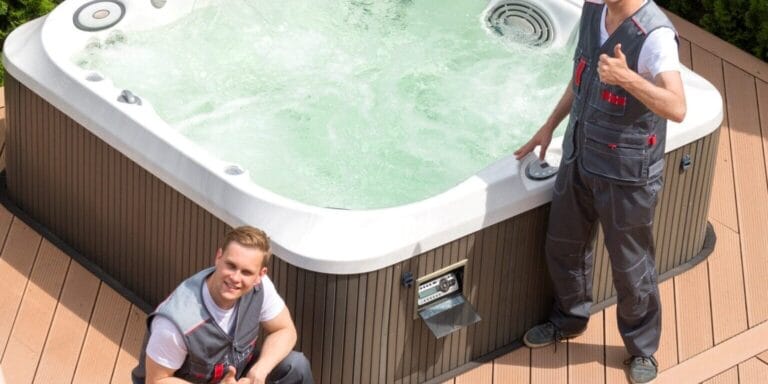
Your new AquaLife hot tub is sitting on the patio. The water’s in. The jets are ready. And then someone asks: “So… who’s doing the electrical?”
This is the part most hot tub buyers underestimate. The soak itself is simple. The electrical setup behind it is not something to guess at. Water and electricity are an unforgiving combination, and the difference between a safe installation and a dangerous one often comes down to a few specific decisions — the right breaker size, a properly placed GFCI disconnect, correct grounding and bonding.
This guide covers all of it. Whether you’re getting a budget-friendly plug-and-play model like the AquaLife Current or a full-power 240V spa like the Grand Banks, here’s exactly what proper hot tub electrical installation looks like — and what to insist on when you hire an electrician.
First: Know Which Type of Hot Tub You Have
Before a single wire gets run, you need to know your spa’s voltage requirement. AquaLife models fall into two categories, and the installation process is genuinely different for each.
120V Plug-and-Play Hot Tubs
Models like the AquaLife Current and Outback™ operate on standard 120V power and include a built-in GFCI cord. You plug into a dedicated 120V/15A outlet and you’re running. No electrician required for the connection itself — though you should still verify the outlet is on a dedicated circuit and is GFCI-protected.
The trade-off with 120V is heating speed. At 1kW of heating output, these spas take longer to reach temperature — figure 8–12 hours from cold, depending on your climate and starting water temperature. For casual use a few nights a week, that’s manageable with a timer. For daily soakers or cold-weather use, a 240V model heats faster and holds temperature more efficiently overnight.
240V Hardwired Hot Tubs
Models like the AquaLife Inland™, Surfaces, Grand Banks, and Insight run on 240V and require a dedicated hardwired circuit installed by a licensed electrician. These spas power 4kW stainless steel heaters and multi-pump jet systems simultaneously — the electrical demand is in a completely different category from a plug-and-play unit.
240V installation is a non-negotiable professional job. If someone tells you otherwise, that’s a red flag.local electrical codes and National Electrical Code (NEC), Article 680 specific to pool and spa installations.
The Code That Governs All of This: NEC Article 680
Every hot tub installation in the US must comply with the National Electrical Code (NEC), Article 680 — the section specifically written for pools, spas, and hot tubs. Your local municipality may have additional requirements on top of this, but NEC 680 is the national baseline.
The rules that matter most for a hot tub installation:
- A GFCI-protected disconnect must be installed within sight of the spa but no closer than 5 feet from the water’s edge
- All receptacles within 10 feet of the spa must be GFCI-protected
- No standard wall switches, lighting fixtures, or outlets may be located within 5 feet of the spa
- All metal components — pumps, heater housing, handrails, cabinet frame — must be bonded together to equalize voltage potential
- Outdoor wiring must run through approved conduit (PVC or flexible metal conduit for wet locations)
Your electrician will know these rules. Bring them up anyway so you can confirm they do.
Step-by-Step: What a Proper 240V Hot Tub Installation Looks Like
Step 1 — Start With a Licensed Electrician
This is non-negotiable for any 240V spa. A licensed electrician will assess your panel’s current capacity, determine whether a subpanel is needed, pull the required permit, and ensure the final installation passes inspection.
When you call, ask specifically: “Have you wired hot tubs or spas before, and are you familiar with NEC Article 680?” Most pool and spa electricians are. A general handyman is not the right person for this job.
Step 2 — Dedicated Circuit, Correct Breaker Size
A hot tub must have its own dedicated circuit — nothing else on the same breaker. For most AquaLife 240V models, you’ll need a 50-amp, two-pole GFCI breaker. Some larger multi-pump models may call for 60 amps. Always check the spec sheet for your specific model before the electrician orders materials.
The GFCI breaker can be installed either at the main panel or in a weatherproof disconnect box near the spa. Either works — what matters is that GFCI protection exists somewhere on the circuit.
Step 3 — Wire Gauge and Conduit
For a standard 240V, 50A hot tub circuit, the correct wire is 6 AWG copper — run as a 4-wire cable (two hots, one neutral, one ground). Don’t let anyone substitute aluminum wire for copper on this run. Aluminum corrodes at connection points over time, increases resistance, and creates fire risk. Copper only.
All outdoor wiring must run through conduit — either Schedule 40 PVC for underground runs or flexible metal conduit where the line surfaces near the spa. Wiring left exposed or run loosely through a crawlspace is a code violation and a genuine hazard.
Step 4 — GFCI Disconnect Placement
The disconnect box is the shut-off point between your spa and the power supply. NEC 680 requires it to be:
- Within line of sight of the spa (so someone in the tub can see it)
- At least 5 feet from the water’s edge
- Weatherproof — rated NEMA 3R minimum for outdoor locations
- Mounted on a solid, non-metallic surface where possible
This placement matters. A disconnect that’s too close to the water is a code violation. One that’s out of sight defeats the safety purpose.
Step 5 — Grounding and Bonding (Don’t Skip This)
These are two separate things that people often confuse.
Grounding connects your spa’s electrical system to the earth, giving fault current a safe path to flow if something goes wrong. Bonding connects all metal components — pump housings, heater casings, handrails, the water itself — to a common bonding wire, equalizing voltage potential between them.
Bonding is the step that prevents what’s called “voltage gradient” — a situation where two metal parts at slightly different voltages create a shock path through the water between them. It’s invisible, it’s dangerous, and it’s entirely preventable with proper bonding.
Both steps are required under NEC 680. Both must be done. If an electrician tries to skip bonding because “it’s just a residential spa,” find a different electrician.
Step 6 — Weatherproof Everything
Every electrical component that lives outdoors near your spa needs weatherproof-rated housing.
- Junction boxes: must be above ground level and weathertight
- All connectors and fittings: rated for wet locations (NEMA 3R or 4X)
- Conduit entry points: sealed with appropriate fittings to block moisture ingress
- Cable runs: never routed across walking surfaces where they can be damaged
Install drip loops at any point where a cable enters an enclosure. A drip loop is exactly what it sounds like — a low point in the cable run that lets water drip off before reaching the entry point, rather than running straight in.
Step 7 — Test Before You Soak
Before the first fill, your electrician should test the circuit with a meter, verify the GFCI trips correctly when tested, and confirm all controls — heater, pumps, jets, lighting — power up without issue. Check for any signs of arcing, burning smell, or tripped breakers during the first power-on.
After that, you’re clear. Fill it, heat it, and enjoy it.
Common Wiring Mistakes That Cause Real Problems
Most hot tub electrical incidents aren’t random failures — they’re the result of specific, avoidable mistakes. Here’s what to watch for:
- Shared circuits — running the spa off the same breaker as a washer, air conditioner, or any other appliance
- Missing GFCI protection — the single most dangerous omission possible
- Undersized wire — 8 AWG or 10 AWG on a 50A circuit gets hot under load; 6 AWG copper is the minimum
- No bonding — invisible risk that can cause shock in the water
- Poor conduit connections — gaps where moisture enters and corrodes wiring over time
- Disconnect too close to the spa — inside the 5-foot safety zone required by NEC 680
- DIY panel work — adding a breaker to a main panel without the knowledge to do it safely
If your installation was done by a previous homeowner and any of these conditions exist, have a licensed electrician inspect and correct the work before using the spa.
Ongoing Electrical Maintenance
Installation is the hard part, but a few simple habits keep everything safe long-term.
Every 3–6 months:
- Press the GFCI test button, then the reset button — confirm it trips and resets correctly
- Visually inspect conduit runs and junction boxes for cracks, corrosion, or water intrusion
- Listen for any unusual hum or vibration from the pump motor during startup
Annually:
- Have your electrician do a torque check on all grounding and bonding connections — these can loosen over time, especially with temperature cycling
- Inspect the power cord and GFCI plug on plug-and-play models for any cracking or discoloration
- Schedule a full inspection before heavy winter use if you’re in a cold climate
When to Call an Electrician Immediately
Don’t wait on any of these:
- A breaker that trips repeatedly and won’t stay reset
- Any burning smell near the control panel or disconnect box
- Spa lights that flicker without explanation
- A tingling sensation when touching the water or the spa shell
- Visible melting, scorching, or corrosion on any electrical component
These are not minor maintenance issues. Turn the spa off at the disconnect, don’t use it, and call a licensed electrician the same day.
Permits and Legal Requirements
Most municipalities require an electrical permit before a 240V hot tub installation, and an inspection after. This isn’t bureaucracy for its own sake — it’s what ensures someone qualified verifies the work before you get in the water.
Permits also matter for insurance. If an unpermitted installation causes a fire or injury, your homeowner’s insurance policy may deny the claim. Pull the permit. It’s worth it.
Energy Efficiency: Getting the Most From Your Electrical Setup
Once you’re safely wired, a few habits meaningfully reduce your monthly running costs:
- Use your spa’s timer — schedule heating to reach temperature just before your regular soak time, rather than holding peak temperature all day
- Keep the insulated cover on between uses — AquaLife spas ship with a full insulated locking cover that does real work retaining heat overnight
- Schedule heating during off-peak hours if your utility offers time-of-use rates — typically late night to early morning
- Switch to LED lighting if your model allows — the efficiency difference versus incandescent is significant over thousands of hours of spa lighting use
Good wiring and smart habits together make a hot tub far cheaper to run than most buyers expect.
FAQs
Can I plug my AquaLife hot tub into a regular outlet?
Only plug-and-play models (120V) — like the Current and Outback™ — are designed for standard outlet use, and those outlets must be GFCI-protected and on a dedicated 15A circuit. All 240V AquaLife models require hardwired installation by a licensed electrician.
How far does the outlet or disconnect need to be from the hot tub?
The GFCI disconnect must be at least 5 feet from the water’s edge under NEC Article 680. Standard receptacles must be at least 10 feet away.
Do I need a permit to install a 240V hot tub?
In most jurisdictions, yes — both an electrical permit and a final inspection are required. Check with your local building department before starting work.
What size breaker does a 240V AquaLife hot tub need?
Most models require a 50-amp, two-pole GFCI breaker. Always verify against your specific model’s spec sheet — some larger multi-pump configurations may call for 60 amps.
How often should the wiring be inspected?
Test the GFCI monthly, do a visual inspection every 3–6 months, and have a professional inspection annually — especially before the first heavy use of the season.
What’s the difference between grounding and bonding?
Grounding gives fault current a safe path to earth. Bonding connects all metal components to equalize voltage potential between them and prevent shock through the water. Both are required under NEC 680.
Not Sure Which AquaLife Model Is Right for Your Electrical Setup?
If you’re still deciding between a plug-and-play 120V spa and a hardwired 240V model, the electrical requirements are a real part of that decision — not an afterthought. A 120V plug-and-play spa like the Current or Outback™ gets you soaking with minimal installation. A 240V spa like the Inland™, Surfaces, or Grand Banks delivers significantly more heating power and jet performance — worth the installation investment for daily users.
Browse the full AquaLife hot tub range or visit the AquaLife Amazon store for current pricing and availability.