The first big decision when you buy a hot tub isn’t the color or the number of jets. It’s the power supply. A plug and play hot tub runs from a normal 120V household outlet. A 240V hot tub is hardwired by an electrician to its own circuit, like a dryer or an electric range. That one choice decides how fast your spa heats up, how many jets can run at once, what you pay to install it and, in winter, how happy you are with it.
This guide explains the real differences in plain English, then shows which AquaLife models fall on each side.
The short answer
- Choose plug and play (120V) if you want the lowest upfront cost, have a mild or warm climate, mostly soak with two to four people and want to start using the tub the day it arrives.
- Choose 240V if you live somewhere with cold winters, want strong hydrotherapy from many jets at once, plan to use the tub most days, or want a larger six-plus person spa with loungers.
How the two power types work
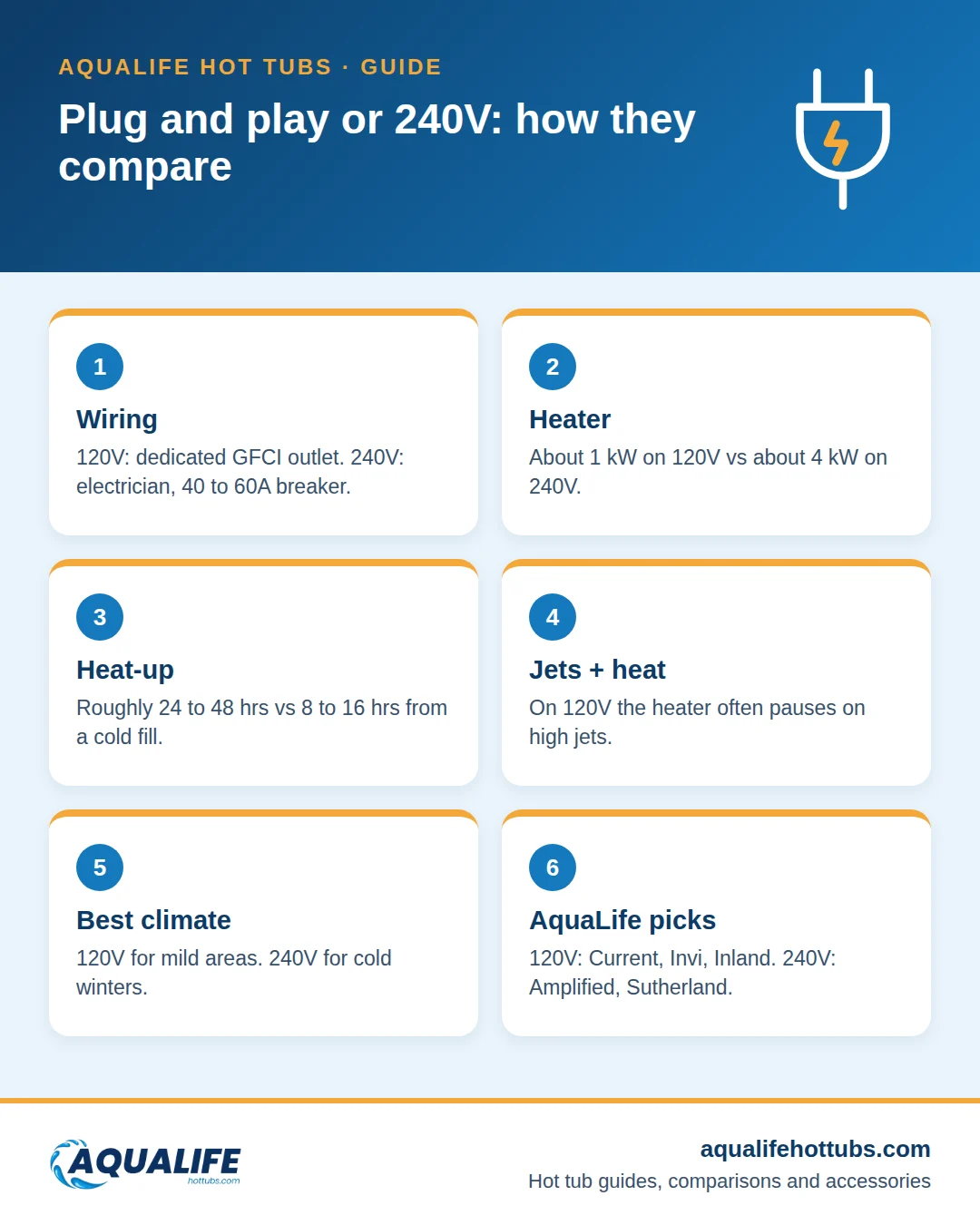
A 120V plug and play spa usually needs a dedicated 15 or 20 amp GFCI-protected outlet. Because a standard outlet can only supply so much power, the heater (often around 1 kW) and the jet pump usually can’t run at full power together. When you switch the jets to high speed, the heater pauses. On a cold night that means the water slowly loses heat while you sit in it.
A 240V spa is wired to a dedicated breaker, commonly 40 to 60 amps depending on the model. That supplies enough power for a much larger heater (around 4 kW on most AquaLife 240V models) and the pumps at the same time. Heat-up is faster, and the water holds its temperature while you use the jets.
Side-by-side comparison
| Factor | Plug and play (120V) | 240V hardwired |
|---|---|---|
| Electrical work | Dedicated GFCI outlet, often none if you already have one | Electrician, breaker, GFCI disconnect and cable run |
| Typical heater | About 1 kW | About 4 kW |
| Heat-up from cold fill | Roughly 24 to 48 hours | Roughly 8 to 16 hours |
| Heater while jets on high | Usually pauses | Keeps running |
| Jet power | Single pump, fewer jets | Two or more pumps, blower, many more jets |
| Best climate | Mild to warm | Any, especially cold winters |
| Best for | 2 to 5 people, casual soaking | 5 to 8 people, daily use, hydrotherapy |
Times are typical ranges. Your actual times depend on the starting water temperature, air temperature, wind and how well the cover seals.
Installation cost: the hidden difference
The tub price is only part of the bill. A plug and play spa may need nothing more than a suitable outlet within reach of the cord (never use an extension cord). If you need a new 120V circuit, it’s usually a small job.
A 240V spa always needs an electrician. The cost depends on the distance from your main panel, whether your panel has spare capacity, and local permit rules. Ask for a written quote before you order the tub, and read our hot tub electrical installation guide so you know what to ask for: breaker size, wire gauge, GFCI disconnect location and permit.
Running costs
People often assume plug and play spas are cheaper to run. Not always. A small heater runs for longer to reach the same temperature, and in cold weather it may struggle to keep up at all. A well-insulated 240V spa heats fast, then idles. In mild climates the 120V spa usually costs a little less per month; in cold climates the gap closes or reverses. A tight, thick cover makes a bigger difference than the voltage. See our guide to what affects hot tub energy consumption and our tips on reducing your hot tub’s environmental impact.
Can you convert a plug and play spa to 240V?
Many plug and play spas, including the AquaLife Current, can be converted to 240V by a qualified electrician. After conversion the heater can usually run while the jets are on. It’s a good middle path: start on 120V, then upgrade if you find the heat-up too slow in winter. Check the manual for your model before you plan on it, and never attempt the change yourself.
AquaLife plug and play models
These models are built to run from a standard 120V outlet:
- AquaLife Current: a compact 4-person spa with 14 stainless jets and a lightweight resin shell, the easiest model to place on a patio.
- AquaLife Invi: a 5-person round plug and play spa with LED lighting.
- AquaLife Inland: 6 people, 24 jets and a faux-wood finish, suitable indoors or outdoors.
- AquaLife Trend: 28 jets with a lounger and a waterfall, still on 120V.
- AquaLife Outback: a round 5 to 6 person resin spa with 20 jets.
The Lagoon (8 people) and Largo LS (dual lounger) can run as plug and play or be wired for 240V, which makes them flexible choices. Compare them in Lagoon vs Largo LS.
AquaLife 240V models
For the strongest hydrotherapy, look at the 240V range:
- AquaLife Amplified: 100 jets with face-to-face double loungers.
- AquaLife Sutherland LS: 6 people, 81 stainless jets and ozone.
- AquaLife Destination: 59 jets driven by four pumps.
- AquaLife Grand Banks and Osprey Harmony LS for six-person lounger layouts.
Not sure between two of them? Our comparisons cover Destination vs Inland, Amplified vs Annapolis and Sutherland LS vs Amplified.
Five questions to decide
- How cold are your winters? Regular freezing nights point to 240V.
- How many people will use it at once? Five or more usually means a bigger 240V spa.
- How do you use the jets? If you want strong massage for 20 minutes or more, 240V keeps the water hot while you do.
- What’s your total budget? Add the electrician’s quote to the 240V price before comparing.
- How soon do you want to use it? Plug and play can be running the day it’s delivered and filled.
Frequently asked questions
Is a plug and play hot tub worth it?
Yes, for many buyers. It’s the cheapest way into a hard-shell hot tub, it’s quick to set up and it works well in mild climates. Just accept that heat-up is slower and the heater may pause during high-speed jets.
Can I put a 240V hot tub on an extension cord?
No. 240V spas are hardwired. For 120V spas, manufacturers also warn against extension cords because they overheat and can trip the GFCI.
Does a 240V hot tub cost more to run?
Not necessarily. It draws more power while heating but heats faster. Insulation, the cover, your climate and how often you open the tub matter more.
What size breaker does a 240V hot tub need?
Commonly 40 to 60 amps, but always follow your model’s manual and your electrician’s advice.
The bottom line
If you want simple, affordable and quick, choose plug and play. If you want year-round heat and real hydrotherapy, choose 240V. Browse the full range on our all hot tubs page, or start with the budget-friendly picks on our affordable hot tubs page.