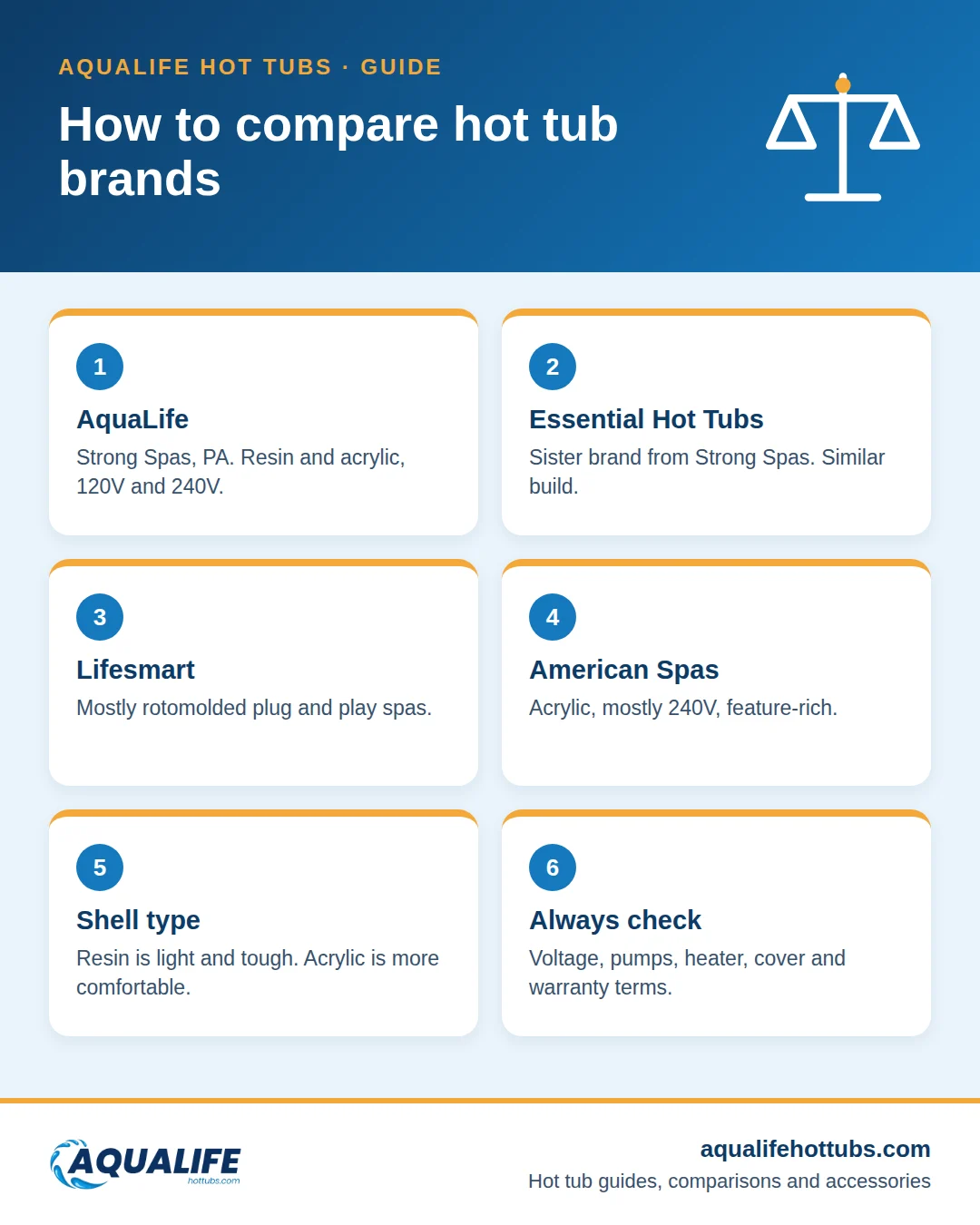
If you’ve been browsing hot tubs on Amazon, Home Depot, Walmart or Costco, the same few brands keep showing up: AquaLife, Lifesmart, Essential Hot Tubs and American Spas. They sit in a similar price band, they ship to your door and most of them include a cover. So how do you choose?
This guide compares them fairly, explains what actually differs between them, and gives you a checklist to apply to any model, whichever brand you pick.
Model ranges and specs change every year. Use this as a guide to what to look for, and always check the current listing and warranty document for the exact model before you buy.
Quick overview
| Brand | Who makes it | Typical shells | Power options | Where it’s sold |
|---|---|---|---|---|
| AquaLife | Strong Spas (Pennsylvania) | Resin (rotomolded) and acrylic | 120V plug and play and 240V | Amazon, Home Depot, Walmart and others |
| Essential Hot Tubs | Strong Spas (Pennsylvania) | Mostly acrylic with synthetic cabinets | Mostly 240V, some 120V | Home Depot, online retailers |
| Lifesmart Spas | Lifesmart | Mostly rotomolded | Mostly 120V, some 240V | Costco, Home Depot, Walmart, online |
| American Spas | American Spas | Acrylic | Mainly 240V | Home Depot, online retailers |
AquaLife: the widest spread from small to large
AquaLife covers the most ground of the four, from small 120V resin spas to 100-jet acrylic loungers:
- Entry plug and play: the AquaLife Current (4 people, 14 jets), Invi and Outback use durable resin shells that are light enough to place on a patio.
- Mid-range: the Inland, Trend, Lagoon and Largo LS add more seats, loungers or 240V options.
- Hydrotherapy flagships: the Amplified, Sutherland LS, Destination and Grand Banks run on 240V with multiple pumps.
Strengths: a model for almost every budget, many stainless jets, ozone on many models, built in the US by an established manufacturer. Watch for: check whether the model you want is 120V or 240V before ordering, and budget for the electrician if it’s 240V.
Essential Hot Tubs: AquaLife’s sister brand
Essential Hot Tubs is another Strong Spas line, so you’ll see similar components, control systems and build quality. The ranges overlap in size and price; the differences are mainly in styling, jet layouts and which retailer stocks which model. If you’re torn between an AquaLife and an Essential model with similar specs, compare the seating layout, jet count, pump count, warranty and delivered price rather than the brand name.
Lifesmart: popular plug and play rotomolded spas
Lifesmart is best known for affordable rotomolded spas that plug into a standard outlet, often sold through warehouse clubs. Rotomolded shells are tough, lightweight and easy to move.
Strengths: low entry price, simple setup, light weight. Watch for: most models have fewer, smaller jets and a smaller heater than a 240V acrylic spa. In cold climates, a 120V spa can struggle to hold temperature with the jets on high. Read plug and play vs 240V hot tubs before deciding.
Closest AquaLife alternatives: Current, Outback and Invi for a resin plug and play spa; the Inland if you want six seats.
American Spas: acrylic 240V spas at retail
American Spas sells acrylic, mostly 240V hot tubs with loungers, LED waterfalls and Bluetooth audio, often through Home Depot.
Strengths: feature-rich acrylic models at competitive prices. Watch for: compare the warranty terms carefully (shell, structure, equipment and labor are often covered for different periods), and check who carries out warranty service in your area.
Closest AquaLife alternatives: Amplified, Sutherland LS, Osprey Harmony LS and Scenic.
Rotomolded vs acrylic: the real difference
Brand matters less than the type of shell:
| Rotomolded (resin) | Acrylic | |
|---|---|---|
| Weight | Light, easy to move | Heavier, needs a solid base |
| Durability | Very impact-resistant | Durable, but can scratch |
| Comfort | Simpler seat shapes | Deeper, contoured seats and loungers |
| Jets | Fewer, usually 1 pump | More jets, often 2 to 4 pumps |
| Price | Lower | Higher |
We compare these in more depth, along with inflatable spas, in our guide to the types of hot tubs.
Buying checklist for any brand
Use this list whichever brand you choose:
- Seats and layout: lounger or bench? How many adults, really?
- Power: 120V or 240V, and what will installation cost?
- Jets and pumps: more pumps means more jets can run strongly at once.
- Heater size: about 1 kW on most 120V spas, about 4 kW on most 240V spas.
- Insulation and cover: a thick, tapered, locking cover saves money every month.
- Water care: ozone or a UV system cuts chemical use. See what a hot tub ozonator does.
- Warranty: read the actual document. Check shell, plumbing, equipment and labor separately.
- Delivery and access: measure gates, paths and the space for the base.
- Real reviews: look for owners describing heat-up times, noise and service.
Frequently asked questions
Are AquaLife hot tubs good?
AquaLife spas are made by Strong Spas, a long-established Pennsylvania manufacturer, and the range covers everything from compact plug and play spas to 100-jet loungers. As with any brand, choose the model that suits your climate and how you’ll use it, and read recent owner reviews for that model.
Is AquaLife the same as Essential Hot Tubs?
They’re separate product lines from the same manufacturer, Strong Spas. Expect similar build quality, with differences in styling, layouts and where they’re sold.
Which brand is best for cold climates?
Any well-insulated 240V acrylic spa with a good cover. Brand matters less than voltage, heater size and the cover.
The bottom line
All four brands make sense for different buyers. Pick the shell type and power option first, then compare specific models. Start with our AquaLife model comparisons or browse all AquaLife hot tubs.