
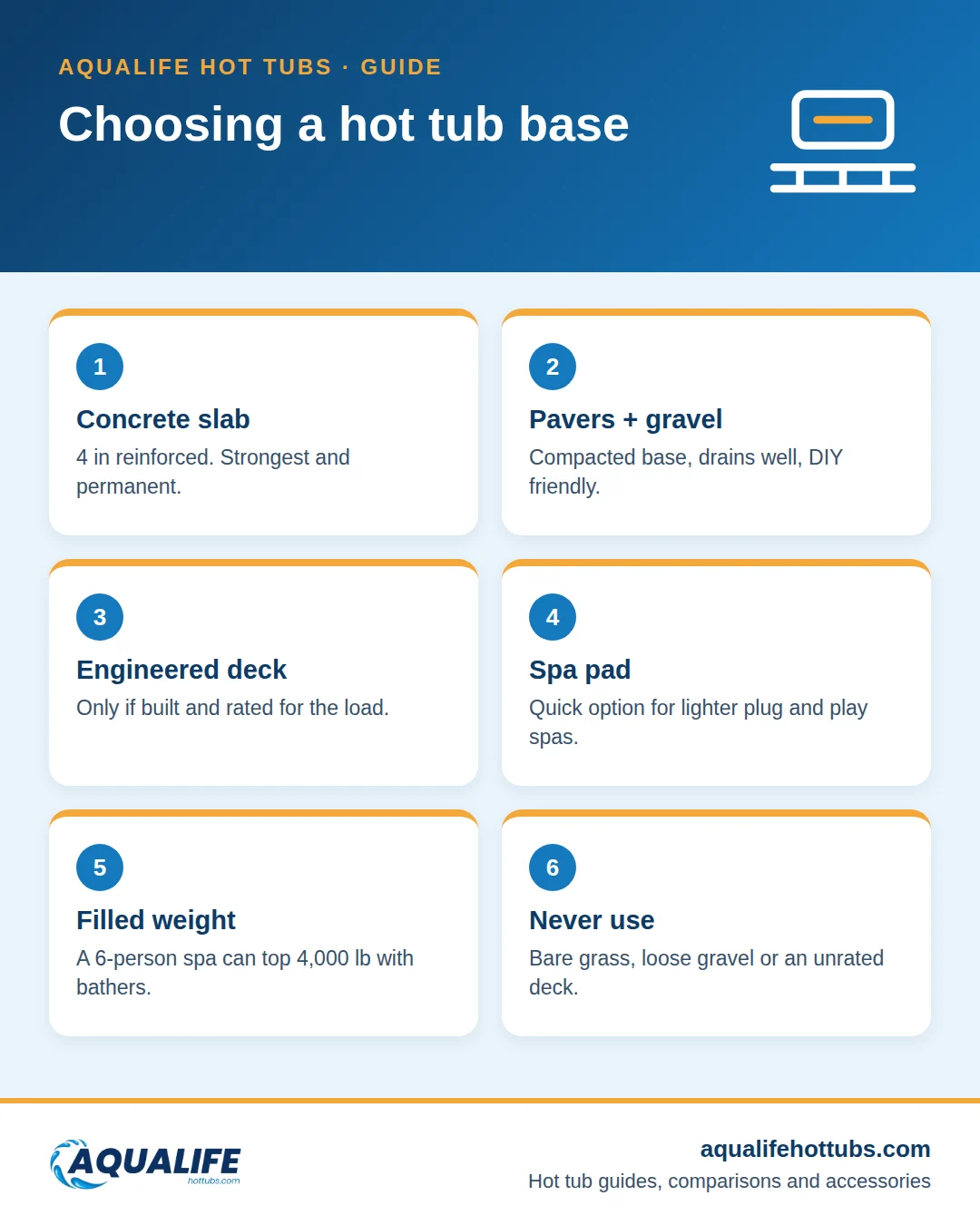
A hot tub full of water and people is one of the heaviest things you’ll ever put in your yard. A 6-person spa can weigh well over 4,000 pounds when filled and occupied. Put it on soft ground, an uneven patio or a deck that wasn’t built for it, and you risk a cracked shell, warped cabinet, failing plumbing and a warranty claim that gets turned down.
The good news: there are four solid base options, and one of them will suit your yard and budget.
The rule every base must meet
Whatever you choose, the base must be:
- Level (most manufacturers allow very little slope, check your manual).
- Solid and fully supporting the entire bottom of the spa, not just the edges.
- Strong enough for the filled weight plus the people in it.
- Well drained, so water doesn’t pool under the cabinet.
- Accessible for service: technicians need to reach every side panel.
How heavy is a filled hot tub?
| Spa size | Typical water (gallons) | Approx. filled weight with bathers |
|---|---|---|
| 2 to 3 person | 200 to 300 | 2,000 to 3,000 lb |
| 4 to 5 person | 300 to 400 | 3,000 to 4,000 lb |
| 6 to 7 person | 400 to 500 | 4,000 to 5,500 lb |
| 8 person | 450 to 550+ | 5,000 to 6,000 lb |
A gallon of water weighs about 8.3 pounds. For more detail, see how many gallons a hot tub holds. Always use your model’s exact dry weight, water capacity and footprint.
Option 1: Concrete slab (the gold standard)
A poured slab, usually 4 inches thick and reinforced with rebar or mesh, is the strongest and most permanent base.
Pros: strongest option, lasts for decades, easy to keep level. Cons: highest cost, permanent, may need a permit, and you’ll need to plan the electrical conduit before pouring. Best for: large 240V acrylic spas such as the AquaLife Amplified or Grand Banks, and anyone who wants a permanent setup.
Tip: Have the electrician run conduit for the hot tub’s electrical supply before the slab is poured.
Option 2: Pavers on a compacted gravel base
Pavers laid over 4 to 6 inches of compacted gravel and a sand bedding layer make an attractive, well-draining base.
Pros: looks good, drains well, DIY-friendly, can be lifted and relaid. Cons: must be properly compacted, or pavers can sink unevenly under the weight. Best for: mid-size spas on a patio, such as the Inland or Lagoon.
Option 3: A deck (only if it’s built for it)
A hot tub can go on a deck, but most existing decks aren’t designed for the load. A filled spa puts concentrated weight on a small area.
Pros: looks great, the tub can be partly recessed for easier entry. Cons: needs a structural engineer or experienced builder, extra footings and joists, and often a permit. Best for: new builds where the deck is designed around the spa.
Never place a spa on an existing deck without checking its load rating first.
Option 4: Prefabricated spa pads
Interlocking plastic spa pads go on top of a leveled and compacted gravel base. They’re quick to install and avoid concrete work.
Pros: fast, affordable, no pouring, good drainage. Cons: the ground underneath must be level and compacted; they suit smaller and lighter spas best. Best for: lightweight resin plug and play spas like the AquaLife Current, Invi and Outback.
What NOT to put a hot tub on
- Bare grass or soil: it settles unevenly and holds moisture against the cabinet.
- Loose gravel alone: it shifts under the weight and point-loads the shell.
- Old, cracked patios: an uneven surface twists the frame.
- An unreinforced deck or balcony.
Base options compared
| Base | Strength | Drainage | DIY friendly | Relative cost |
|---|---|---|---|---|
| Concrete slab | Excellent | Good, if sloped away | No | High |
| Pavers on gravel | Very good | Excellent | Yes | Medium |
| Engineered deck | Good | Good | No | High |
| Spa pad on gravel | Good for smaller spas | Excellent | Yes | Low |
Plan the space around the tub
- Leave at least 18 to 24 inches around the sides for service access (check your manual).
- Think about steps and handrails for safe entry. See options like these hot tub steps with storage and wooden steps with handrails.
- Plan for shade or shelter, such as a hardtop gazebo or pergola.
- Measure delivery access: gates, paths and corners on the way to the base.
- Keep the cover lifter’s swing space clear.
If you ever need to relocate the spa, read how to move a hot tub safely.
Frequently asked questions
How thick should a concrete pad be for a hot tub?
Commonly 4 inches of reinforced concrete, but follow your manufacturer’s guidance and local building rules for larger spas.
Can I put a hot tub on pavers?
Yes, if they sit on a properly compacted gravel base and are perfectly level.
Can a plug and play hot tub go on a deck?
Yes, if the deck is rated for the filled weight. Lighter resin spas are easier, but always check the load.
The bottom line
A solid, level, well-drained base protects your spa and your warranty. Concrete is the best long-term choice; pavers and spa pads suit smaller tubs. Choose your base before you choose your tub, then compare freestanding AquaLife hot tubs that fit the space.